
The Biden Texas Hispanic Campaign Needs an Immediate Realignment

In a recent New York Times story,[i] writer Jennifer Medina discusses the curious support of Donald Trump by Hispanic voters, estimated at 30 percent by recent polls.  Who are these “Latino Trumpers” and how do they justify their support for Trump given the numerous racists comments made by Trump about Latinos and immigrants in addition to the aversive policies targeted to Latinos?

In reviewing general polling results of Latino voters, Medina first discusses some demographic differences among Latino voters.  For example, there is a large gender gapin preferences for the Biden vs. Trump:  Hispanic males (35%) are more likely to support Trump than Hispanic females (23%), while Hispanic females (67%) are more likely to support Biden than Hispanic males (59%).[ii]  This gender gap is partially explained by the higher tendency of Hispanic women to be college educated, while Hispanic men tend be over-represented in jobs related to law enforcement, such as the military, Border Patrol, and Immigration and Customs Enforcement.  In addition, Trump reportedly shows more support from “American born” Latinos who are under 45 years old, non-college graduates, and evangelicals. In Florida, support is reportedly stronger among Cubans and Venezuelans who oppose communism.

To better understand the psychological profile of Latino male Trumpers, Medina analyzes the results of a research study of Mexican male Trumpers that captured their perceptions of Donald Trump. Little information was provided about the study methodology, so proceed with caution in generalizing her observations to other Latinos. Nonetheless, the writer points to the concept of “machismo” to describe Trump’s appeal to Hispanic male Trumpers – a concept that is often used in reference to Hispanic males who are dominant, over-bearing, and indifferent to the needs of others. This rationale for this allure to the “macho” image projected by Trump is described by the following phrases articulated by the Hispanic males who participated in this research study. To Hispanic male Trumpers, Donald Trump:

·       Is forceful, wealthy and unapologetic

·       Is a symbol of economic success

·       Is confident of his own opinions

·       Disdain for face masks is a sign of power

·       Relies on his own research as a basis for denying medical guidance by experts

·       Is committed to the military

In addition, Hispanic male Trumpers enjoy being the subject of curiosity for supporting Trump and willing to tolerate criticism for supporting Trump by friends and family members.  Although the imagery associated with Joe Biden was minimal, these Trumpers described Biden as “weak” and deserving of the title “Basement Biden.”   Thus, Hispanic male Trumpers appear to share the same beliefs and values as Donald Trump, and may not be deserving of attention by the Biden campaign.

Biden’s Campaign is Urged to Step it Up in Texas

Medina’s analysis further underscores several observations by industry experts that the Biden campaign has not invested enough financial resources to engage Hispanics, especially in Texas, where the Biden vs. Trump competition is close.  In a recent news article,[iii] for example,  both Julian Castro and Beto O’Rourke reinforced the message to the Biden campaign that they need to step up their game in Texas during the remaining days before the election on November 3rd.  According to our recent analysis of Latino support for Biden in battleground states, [iv] about two-thirds of Latino voters voiced support for Biden while only one-third supported Trump. With less than 10 days until the election, a new poll by The Dallas Morning News/UT-Tyler of Texas likely voters showed strong continuing support by Latino for Biden (67%) while the support for Trump (20%) has declined — which may be one reason that among all Texas likely voters, support for Biden (46%) is now slightly higher than Trump (44%). It is conceivable that a more aggressive investment of the Biden campaign towards increasing Latino voter turnout could prove to be a significant factor in turning the state blue.    

Strategy Going Forward

Based on Medina’s recent review of the Latino voter profile and my own past experience in conducting surveys of U.S. Latinos, it seems that the Biden campaign needs to make some immediate changes in its Texas Latino voter strategy in the remaining weeks of the election. Following are some suggested ideas.

Delivery Vehicle for Campaign Messaging: First, after months of criticism to step up his game, the Biden campaign reportedly released a series of Spanish-language ads to engage Hispanics.  However, a Spanish-language strategy is a tactical mistake if one is trying to reach native-born Hispanics, especially in Texas.  Our past 45 years of experience in analyzing the media habits of U.S. Hispanics confirms that a majority of native-born Hispanics utilize English-language media for their news and information, while Spanish-language media is more effective in capturing immigrant audiences. Pew Research Center reports also confirm this trend. [v] So the delivery vehicle really needs to change as follows: 75 percent focus on English-language media and 25 percent on Spanish-language media.

Demographic Target:  The most desirable demographic target for Biden should be Hispanic women.  Why?  Because Biden already enjoys great standing among Hispanic women, especially the college-educated, and they would be great ambassadors for convincing other Hispanics who are undecided or independent to support the Biden ticket.  Moreover, Hispanic women are more likely than Hispanic males to be college graduates, politically active, and entrepreneurs.  Hispanic males who share similar attributes as these Hispanic women would also be included as a target segment. However, since Latino male Trumpers share many of the same values and attributes as Donald Trump, it may be a waste of resources to change their fascination with Donald Trump at point in time. 

Message Strategy: Hispanic women should be reminded about the programs and policies advocated by Joe Biden that have benefited Hispanics as well as proposed future programs, especially as it concerns COVID-19, food insecurity, jobs, education, childcare, healthcare, a women’s right to choose, and business development.   

Although climate and environmental issues have not been reported as major concerns in recent polls of Hispanic voters, the most recent Biden vs. Trump debate focused on Biden’s statements about limiting fracking because “the oil industry pollutes, significantly.” Fracking is a technological innovation that has brought fortunes to the economies of the oil and gas industry, especially in states like Texas and Pennsylvania.  When Biden stated that he would not eliminate fracking but transition over time to other types of cleaner and renewable energy, President Trump and GOP members charged that Biden was trying to “destroy the oil and gas industry,” “kill many jobs,”  “Democrats are coming hard for Texas’ oil and gas industry,” and “he just killed paychecks earned by hardworking families in Texas.”   The reality, however, is that the oil and gas industry had already lost 118,000 jobs during the pandemic as demand and prices for oil fell dramatically. [vi]  According to an industry research firm, it would take more than 16 years to recover the energy jobs lost since February. [vii]  As underscored by Joe Biden, renewable energy is the best solution for the future, has surged sharply with the downturn in the oil and gas market, creating numerous jobs, and providing a cleaner environment for families.

The fracking debate should be a top concern for Texas Hispanic voters.  While it has provided jobs and a significant boost to the Texas economy, fracking comes at a heavy cost to the environment and the health of Hispanics and other poor families who live in close proximity to these fracking sites.  The following map shows the distribution of the 415,354 oil and gas facilities in Texas as of 2017 (black points) and the distribution of the state’s schools and day care facilities (lighter points). [viii] 
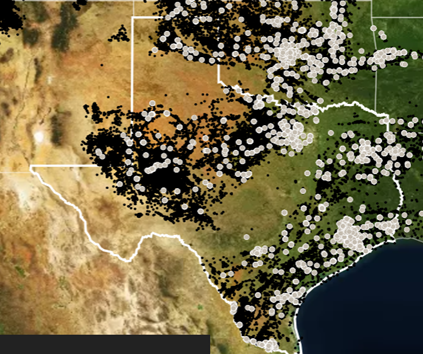
The web site authors define a threat radius as the area within ½ mile of active oil and gas wells, compressors and processors. Persons who live within a threat radius have cause for concern about potential health impacts from oil and gas pollution. An estimated 782,627 students live within a threat radius. This pollution includes dangerous chemicals that have been associated with various medical illnesses to residents living in close proximity to these sites, including the following:

·       Congenital heart defects

·       Cancer

·       Anemia

·       Brain damage

·       Respiratory tract infections

·       Oral clefts and neural tube defects

In Texas, the oil and gas facilities are concentrated in highly populated Hispanic and lower income communities.  In addition to a higher prevalence of these medical illnesses, the fracking process utilizes large amounts of water that is draining the water resources for many of these communities, some which are also experiencing drought conditions.

The conclusion for messaging seems clear:  Joe Biden should be honored, not criticized, for taking the bold step to protect our environment and the health of our residents from the toxic pollutions that are generated by fracking sites.  Hispanic campaign messaging should include information about the consequences of fracking to their families’ health and environments – a message that may resonate more strongly with Hispanic women but may also capture the attention of Hispanic males who are exposed to these toxic work environments.

A Final Thought:  The profile of Hispanic male Trumpers describes a person that is fascinated with power and an indifference to factual information about Trump’s achievements. As a long shot strategy, it may be useful to include messaging for Hispanic male Trumpers to clarify the following misconceptions that were previously voiced about Donald Trump:

·       Trump is a successful businessman. If Trump is so successful, why is he over $1 billion in debt, and why has he filed for bankruptcy several times in past years? [ix]

·       By not using a mask, Trump shows that he has power. Rather than symbolizing power, not using a mask reveals ignorance of medical advice that is known to save lives. Hispanics, in particular, are experiencing more COVID-19 illnesses and deaths than other groups in the U.S. This is not power.

·       Trump does his own research to reach his own conclusions.  Trump has no medical training or knowledge and often ignores the scientific advice of experts, especially on health issues. An example of his ignorance was his advice for using Lysol disinfectant to treat the coronavirus.

·       Trump respects the military.  On the contrary, Trump has been disrespectful of war heroes like the late Sen. John McCain and called soldiers who died in European war “suckers and losers.” He avoided military service due to a supposed bone spur medical diagnosis arranged by his father. Trump often disparages our military leaders but idolizes world dictators who have historically oppressed their people.

·       Trump shows confidence in his opinions, but his opinions are usually based on lies that contradict the scientific facts. If science does not matter, do you also ignore the advice of doctors that prescribe medications and perform surgeries — both which are based on the results of scientific research?   

·       Trump is not a racist. If Trump is not a racist, why did his administration separate Hispanic children from their families? There are now 545 Hispanic children in U.S. custody who were separated by the Trump administration from their parents, and their parents cannot be found.


In summary, a successful strategy to turn Texas blue during this election may depend on the ability of the Biden campaign to accelerate their targeting of Hispanic voters, especially women, with the right messaging using English-language media.  Let’s hope that Biden’s campaign manager is listening.


[i]Medina, J. (2020, October 14).  The macho appeal of Donald Trump.  The New York Times. Access at https://www.nytimes.com/2020/10/14/us/politics/trump-macho-appeal.html

[ii]Krogstad, J.M. and Lopez, M. H. (2020, October 20).  Latino voters have growing confidence in Biden on key issues, while confidence in Trump remains low.  FACTTANK, Pew Research Center. Accessed at https://www.pewresearch.org/fact-tank/2020/10/16/latino-voters-have-growing-confidence-in-biden-on-key-issues-while-confidence-in-trump-remains-low/

[iii]Gillman, T.J. (2020, October 22).  Beto O’Rourke and Julian Castro fume that Biden has neglected Texas, demand ‘crunch time’ investment.  Accessed at https://www.dallasnews.com/news/politics/2020/10/22/beto-orourke-and-julian-castro-fume-that-biden-has-neglected-texas-demand-crunch-time-investment/

[iv]Rincon, E.T. Polls provide conflicting views of Hispanic support for Biden vs. Trump. The Culture of Research Blog, Accessed at  https://thecultureofresearch.blogspot.com/2020/09/polls-provide-conflicting-views-of.html   

[v]   Lopez, M.H. and Gonzalez-Barrera, A. (2013, July 13).  A growing share of Latinos get their news in English. Pew Research Center. Accessed at:  https://www.pewresearch.org/hispanic/2013/07/23/a-growing-share-of-latinos-get-their-news-in-english/

[viii]   Source: Oil and Gas Threat Map (2020, October 24).  Accessed at https://oilandgasthreatmap.com/threat-map/texas/

[ix]Alexander, D. (2020, October 16).  Donald Trump Has At Least $1 Billion In Debt, More Than Twice The Amount He Suggested. Forbes,  https://www.forbes.com/sites/danalexander/2020/10/16/donald-trump-has-at-least-1-billion-in-debt-more-than-twice-the-amount-he-suggested/#632ff0f14330


Massive Census Under-Count Likely as Trump Forces Cut of 30 Days from Data Collection Schedule

As reported recently by National Public Radio on July 30, 2020, the Census Bureau announced that they have changed the end of data collection for Census 2020 from October 31 to September 30 – essentially cutting 30 days from the critical door knocking period used to reach hard-to-count communities. [1]  Under condition of anonymity, Census Bureau employees involved in overseeing local census offices voiced their concerns about this action:  “It’s going to be impossible to complete the count in time,” and “I’m very fearful we’re going to have a massive under-count.” 

The Democratic party is understandably very concerned with the Census Bureau’s decision. Why?  Because 40 percent of the American public has not completed the Census 2020[2]  and most of these non-respondents or “hard-to-count” persons include Hispanics, Blacks and immigrants that have historically voted for Democratic candidates.  This fact has not been lost on Republicans.

A substantial Census under-count would have serious political and economic consequences for many communities. Because the decennial census is used to determine a state’s legislative seats and Electoral College votes, an under-count could significantly change the political landscape to the advantage of the Republican party. In addition, the 2010 census counts were used for the distribution of $589.7 billion of federal tax dollars for Medicare, Medicaid, and other public services to 50 states and the District of Columbia – services that often support communities of color.  Importantly, a substantial under-count in any one state could lead to the diversion of funds away from that state to other states and uses. [3]  As explained more clearly by Andrew Reamer, Research Professor with the GW Institute of Public Policy: 

“For the large majority of programs, money lost due to an under-count doesn’t go back to the U.S. Treasury, it is spread around all other communities. For each program, Congress determines the size of the pie, the census data determine each community’s share of the pie. For each $1 Texas loses due to an under-count, California gets an extra 14 cents, more or less. My expectation is that Texas’s decision to not have a statewide complete count effort will annually add several millions of dollars to California’s treasury, courtesy of Texas taxpayers.” [4]

Steve Dillingham, the Census Bureau director and a Trump appointee, provided lawmakers little insight about the rationale for the recent timing change during recent testimony before the House Oversight and Reform Committee. Nonetheless, House member Gomez gave Mr. Dillingham a stern warning:


“It seems like there’s an obvious pattern that you’re not in control of the Census Bureau……your name will go down in history if this is the worst census ever conducted by the United States government.  You’re not going to runaway and say that this was only because of the Trump administration later on.  You will be responsible.” 


The change in the Census Bureau’s data collection schedule reflects the Trump administration’s growing desperation to control the outcome of the November election, and follows a series of other efforts to undermine the voting clout of groups that have typically supported the Democratic party, [5]such as attempting to include a citizenship question in the Census 2020 questionnaire, fabricating information about widespread voter fraud to discourage mail-in ballots, and delaying funding for the financially strapped U.S. Postal Service to undermine the efficient processing of mail-in ballots in the upcoming November election.

Given the high stakes consequences associated with a potential massive Census under-count, it is imperative that communities throughout the U.S. accelerate their efforts to increase response rates among hard-to-count communities.  With a current non-response rate of 40 percent, it is safe to assume that the strategies that have been employed thus far have not been very effective in engaging hard-to-count communities.  Therefore, following are some suggested strategies for providing hard-to-count communities an additional boost to complete the Census 2020 questionnaire over the next two months:

·       The messaging must personalize the consequences to families of not completing the Census questionnaire:  the loss of funds for school lunches, healthcare for mothers and children, food and nutrition programs for the poor and unemployed, immigrant support, etc. The message should also remind community members that a citizenship question is not included in the Census 2020 questionnaire.  The urgency of the messaging must be elevated and impactful. Old message concepts may not suffice at this point.

·       With a high penetration rate across varied demographic groups, wireless telephones should be used in communicating with hard-to-count communities and also include a link to the Census 2020 online questionnaire.

·       Hispanics must receive messaging in both English and Spanish since immigrant adults are more likely to communicate in Spanish, while children and non-immigrants are more likely to communicate in English. 

·       Retailers whose profitability depends on the economic viability of hard-to-count communities should also do their part to encourage customers to complete the Census questionnaire through store displays and paid advertisements.

·       High technology companies should allocate grants to expand the distribution of laptops and portable wi-fi devices to families during the next two months to facilitate the completion of the online Census questionnaire.

·       There are numerous non-profit and community organizations that serve hard-to-count communities and maintain frequent communication with their membership, such as churches, immigrant advocacy groups, soccer teams, baseball teams, football teams, basketball teams and others.  Such organizations should take advantage of the reach and trust that they have earned to promote completion of the Census 2020 questionnaire.

·       Trusted and recognized business and civic leaders from local communities of color should be included in all advertisements that promote completion of the Census 2020 questionnaire.


September 30, 2020 is the new deadline to complete the Census 2020, so there is little time left for communities to mobilize their outreach efforts.  A massive census under-count threatens the political and economic stability for all communities, regardless of political orientation, and needs to be taken seriously by everyone.

References


[1]Wang, H.L. (2020, July 30).  Census door knocking cut a month short amid pressure to finish count. NPR, access at https://www.npr.org/2020/07/30/896656747/when-does-census-counting-end-bureau-sends-alarming-mixed-signals

[2]Census Bureau Response Rates. Accessed at https://2020census.gov/en/response-rates.html

[3]Reamer, A.  (2018, March 19).  Counting for dollars: The role of the decennial census in the geographic distribution of federal funds. GW Institute of Public Policy, The George Washington University. Accessed at  https://gwipp.gwu.edu/counting-dollars-2020-role-decennial-census-geographic-distribution-federal-funds

[4]Reamer, A. (2020, February 26). Personal communication via email.

[5]Rincon, E.T. (2020, February 17). Undermining the 2020 Census: Trump’s Toxic Brew of Crime, Hysteria and Immigrant.  Accessed at  https://www.rinconassoc.com/undermining-the-2020-census-trumps-toxic-brew-of-crime-hysteria-and-immigrants

CDC Blunders in Excluding Communities of Color Among High Risk Groups for Covid-19

It really makes little sense.  Despite the fact that Blacks, Hispanics and Native Americans are being hospitalized and dying at considerably higher rates than whites in the U.S., the Center for Disease Control recently changed its definition of Covid-19 high risk groups to exclude these groups.[i]  Why?  Because they have concluded that the high virus rates are not due to genetics, and they want to avoid stigmatizing these groups as “Covid carriers.”  By taking this action, the CDC can now remove their priority status for the delivery of health services – a disturbing action that suggests the injection of partisan politics.
 Let’s consider the fact that older persons were initially identified among the high-risk groups and remain in that category for good reasons. Indeed, one would not argue that their high-risk status should be changed because they often reside in nursing or retirement homes that have been plagued by the coronavirus. The purpose of identifying key demographic characteristics that are associated with the prevalence of a disease or virus is to target intervention strategies towards such groups as quickly as possible to mitigate the spread of the disease or illness – regardless of the circumstances that created their vulnerability – such as social determinants like comorbidities, living arrangements and working conditions.  

The CDC’s justification for re-defining the high-risk categories – to avoid stigmatizing these groups as “Covid carriers” – is specious.  Communities of color have long been stigmatized in many industries for the wrong reasons, including their skin color, language and many other attributes.  Assigning a high-risk category for Covid-19 is a health-related assessment, not a stigma, and should not be used as a basis for denying health-related services as the CDC is apparently proposing.
What seems plainly obvious is that the Trump administration has forced the hand of the CDC experts once again.  First by re-directing the reporting of Covid-19 hospitalizations from the CDC to the Dept. of Health and Human Services to the great dismay of the national health community.  Secondly, by pressuring the CDC to moderate the perceived risk of attending schools in person despite the increasing infection rates in many communities. And now by re-defining Covid-19 high risk groups with a questionable rationale.
These actions are setting the stage in the U.S. for the unfair distribution of the Covid-19 vaccine once it becomes available, a disturbing scenario that is likely to deprive the vaccine from communities of color and other groups that have been re-defined as lower risk by the CDC. By allowing this new definition of risk by the CDC to continue unchallenged, communities of color can expect a longer period of infections and mortalities from the pandemic, and more limited access to a vaccine once it becomes available.  There is a clear need for strong advocacy from civic, business and community groups that represent communities of color to challenge and correct the direction that the CDC has taken in defining high-risk groups for Covid-19.   
References


[i]Associated Press (2020, July 25). US agency vows steps to address COVID-19 inequalities.  WFAA, accessed at https://www.wfaa.com/article/news/health/coronavirus/coronavirus-inequalities-cdc/507-a770cfc8-9967-4359-b84d-12684c6aa46f
 

President Trump Launches a Civil War Against the American Public

As the November presidential election nears, there are noticeable palpitations from the Trump campaign and his supporters, which has prompted an undeclared civil war against the American public. Fueling the anxiety level throughout the Republican party is Trump’s epic failure in acknowledging and managing the Covid-19 pandemic as well as the double-digit lead by Joe Biden in several national polls. To breathe new life to his failing campaign strategy, Trump has chosen to heighten the misery index across the country with a series of actions designed to weaken the democratic electorate and keep his job for another term.   Following is a sampling of the extreme and somewhat bizarre actions that the Trump administration has directed at the American public:
Voting and Apportionment 
·       Aggressive efforts to eliminate the use of mail-in ballots despite little evidence of voter fraud and the potential exposure of voters to Covid-19 infections.  According to recent research by the Pew Research Center,  “About two-thirds of Americans say the option to vote early or absentee should be available to any voter without requiring a documented reason, while a third say early and absentee voting should only be allowed with a reason. Democrats overwhelmingly back “no excuse” early or absentee voting: 83% support it. By comparison, 55% of Republicans say a documented reason should be necessary to vote early or absentee.” [1]  
·       Attempts to include a citizenship question in the Census 2020 questionnaire designed to discourage immigrant participation in the census – later rejected by the U.S. Supreme Court.
·       Recently signing an executive order to remove counts of unauthorized immigrants from the Census computations used to define legislative districts – an action that will be legally challenged by several civil rights organizations. According to recent analysis of government data by Pew Research, the removal of these immigrants would mean that three states each could lose a U.S. House seat, while three others each could gain one.
Covid-19
·       Stating the “testing was over-rated,” Trump has delayed increasing the level of funding for Covid-19 testing and tracking despite the growing surge in infections and mortalities throughout the country.
·       A refusal to issue a federal mandate to expand the availability of personal protective equipment (PPE).
·       Trump actually recommended the use of a disinfectant like Lysol to treat Covid-19 patients.
·       Requiring hospitals to re-direct records related for Covid-19 hospitalizations from the CDC to the Department of Health and Human Services – considered by the nation’s healthcare professionals as a political attempt to obscure the true picture of Covid-19 infections and mortalities. Further evidence that the Trump administration is politicizing the data collection and analysis the pandemic data is the recent announcement by the CDC that race and ethnic minorities are no longer considered high risk or meriting higher priority for certain health services [2]. Why?  Because their Covid-19 high hospitalization, infection and mortality rates result from social determinants, not genetics, and there is a need to avoid stigmatizing and victimizing these groups.  While social determinants are indeed important factors that contribute to the higher prevalence of Covid-19 in Black and Hispanic communities, it makes little sense to use this as a basis for removing their high risk designation — indeed, they are still at high risk regardless of the circumstances that placed them at high risk.
·       The continued failure to order a national mandate for wearing face masks despite the advice of global medical experts.
·       The failure to clear up the large amount of missing race-ethnic data related to Covid-19 mortalities which greatly underestimates the mortality rates for communities of color. According to Janet Hamilton, executive director of Council of State and Territorial Epidemiologists, race and ethnicity data is missing 80% to 85% of the time, while patient address and telephone numbers are missing as much as 50% of the time.  A standard form to record such information if often not used by physicians since it is not considered a priority. [2]
·       The failure to increase OSHA inspections of employers to check compliance with CDC recommended practices related to Covid-19 employment policies. Clusters of Covid-19 infections have grown rapidly in factories and food suppliers where employees are forced to work in close proximity without the proper protective equipment.
Education
·       Pressuring schools to allow in-person instruction despite the high Covid-19 infection rates in their communities and the increased potential of exposure to students and teachers.
·       Issuing an executive order requiring foreign students in U.S. academic institutions to attend in-person classes despite Covid-19 risk — later rescinded due to many protests from U.S. academic institutions and private high-tech employers.
Abusive Actions
·       Using tear gas and injuring residents engaged in peaceful protests, as recently occurred at protests at the White House and Portland, Oregon.
·       Threatening to send Federal agents to quell peaceful protests regarding Black Lives Matter, especially in “Democratic” cities like Chicago and Albuquerque.
·       Supporting the presence of the Confederate flag, statues and similar symbolism in public places that are racially divisive.
Immigration
·       Misportraying immigrants as criminals despite substantial evidence that their crime rates are lower than native-born residents in the U.S.
·       Failure to process new DACA (i.e., Dreamer) applications despite a recent ruling by the U.S. Supreme Court to allows this process.
Coupled with the support of the Republican party, Trump’s civil war against the American public will likely diminish voter participation among Democrats during the upcoming November election, expand the spread of Covid-19 infections and mortalities, and generally deteriorate the quality of life for all U.S. residents. This level of aggression towards the American public is perplexing, especially given that our political leaders are sworn to protect U.S. residents, not harm them. 
This is not the first time, however, that Trump’s patriotism for his countrymen has been the subject of some controversy. For example, Trump has consistently praised world dictators that are known to oppress the human rights of their constituents and disparaged recognized war heroes like the late Sen. John McCain.  According to a news report, Trump avoided military service during the Vietnam conflict due to a bone spur, which earned him the title “Cadet Bone Spurs” – a term attributed by Senator Tammy Duckworth, a Purpose Heart recipient.  A story in the New York Times [3]reported that a foot doctor in Queens who rented his office from Mr. Trump’s father, Fred C. Trump, suggested that the diagnosis was granted as a courtesy to the elder Mr. Trump. In addition to avoiding military service, Mr. Trump continues to show his support for racially divisive Confederate flags and statues.
By accelerating their civil war, Cadet Bone Spurs and his Republican comrades are apparently prepared to win the November election at any cost to the health, safety and civil rights of the American public. For the upcoming November election, voters should seriously question whether Donald Trump and his fellow Republicans deserve to  represent a country whose values and quality of life they have chosen to abandon.  
References

Undermining the 2020 Census: Trump’s Toxic Brew of Crime, Hysteria and Immigrants

In a recent news story, The New York Times tells us that the Trump administration is sending elite tactical Border Patrol teams (BORTRAC) to sanctuary cities that “release dangerous criminal aliens to prey upon the public.” [i]  Sanctuary cities are targeted because local officials have refused to provide  support to ICE in enforcing immigration policies that are perceived as pushing undocumented people further into the shadows, making cities less safe as immigrant become less likely to report crimes or cooperate with investigations.
These BORTAC agents are accustomed to engaging in armed confrontations with drug-smuggling suspects using armored vehicles. They act as the SWAT team of the Border Patrol using such gear as stun grenades and enhanced Special Forces-type training. The officers usually target individuals who are known to be violent with extensive criminal records. Local officials have voiced concerns about the increased militarizing of their communities that could also have deadly consequences. The interventions also result in “collateral arrests” involving innocent family members.    
   
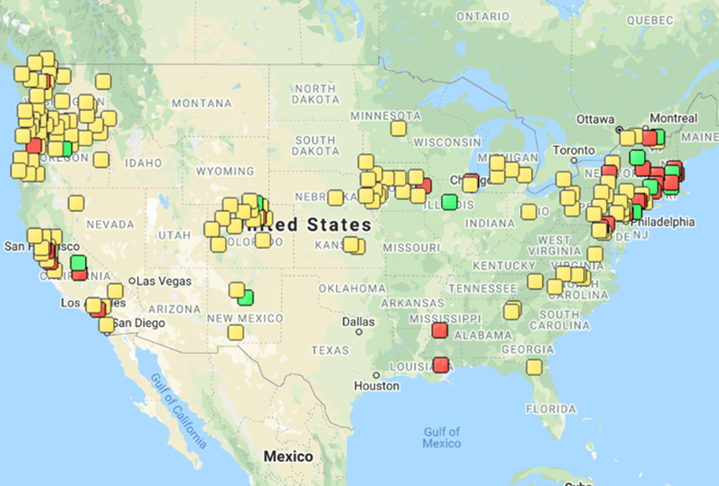
This terror campaign against sanctuary cities is broad in its scope and includes large cities like Chicago, New York, San Francisco, Los Angeles, Atlanta, Houston, Boston, New Orleans, Detroit and Newark, N.J. The map[ii]below, produced by The Center for Immigration Studies, shows the current distribution of sanctuary counties (yellow), cities (red) and states (green) throughout the U.S.  Importantly, there are many communities throughout the U.S. with substantial numbers of immigrants that are not sanctuaries and thus excluded from this map.
Figure 1: Distribution of Sanctuary Cities, Counties and States, 2020
Source:  Center for Immigration Studies, February 2020.

Interestingly, it is no coincidence that the BORTRAC agents are being deployed from February  through May of this year – the same period of time that the 2020 Census is being conducted.   Previously, the Trump administration also worked feverishly to include a citizenship question in the 2020 Census questionnaire which was rejected by the courts due to its potential to discourage response rates of the nation’s immigrant population. Similarly, the deployment of BORTRAC agents is designed to create fear and anxiety among immigrants in sanctuary cities that is likely to discourage participation in the 2020 Census. 
Why does this matter?  Because access to millions of federal dollars by cities throughout the nation are jeopardized by a Census under-count – funds that are used to support schools, hospitals, roads and highways, and other infrastructure needs. The irony is that a Census under-count will impact not just sanctuary cities, but many communities with substantial immigrant populations that are not sanctuaries.  For example, Dallas County is not included in the list of sanctuary counties, but it is estimated that $40 million in federal funds will be lost for every 1 percent drop in the Census response rate. [i]

To justify this reign of terror, the Trump administration explains that the elite agents will assist the targeted communities in handling “dangerous criminal illegal aliens” that are being protected by sanctuary cities. The facts about immigrant crime, however, have established over numerous studies that immigrants do not increase local crime rates, are less likely to cause crime and less likely to be incarcerated than their native-born peers – important facts that were included in a recent review by The Cato Institute regarding immigrant crime rates in the U.S. and the State of Texas. [ii]  In their in-depth analysis of data from the Texas Department of Public Safety, Institute investigators analyzed the arrests and convictions for the year 2015 to determine the extent to which different crimes were conducted by illegal immigrants, legal immigrants and the native born.  The conclusion from their analysis, quoted below, provides concrete evidence that the Trump narrative about “dangerous criminal aliens” is false and misguided:
“The homicide conviction rate for illegal immigrants was 16 percent below that of native-born Americans in Texas in 2015. The conviction rates for illegal immigrants were 7.9 percent and 77 percent below that for native-born Americans for sex crimes and larceny, respectively.  For all criminal convictions in Texas in 2015, illegal immigrants had a criminal conviction rate 50 percent below that of native-born Americans.  Legal immigrants had a criminal conviction rate 66 percent below that of native-born Americans.”  (p.5)
Crime, therefore, is merely a pretext for justifying the deployment of BORTRAC agents in sanctuary communities – a pretentious show of force whose only purpose is to discourage participation of immigrants in the 2020 Census and enhance the political positioning of the Republican party.
Also lost in the campaign to target sanctuary cities are the substantial contributions made by immigrants,  both legal and undocumented, to the U.S. economy, the defense of our nation in times of war, the many patents for inventions at U.S. academic institutions, keeping the Social Security system solvent, and the numerous jobs created by entrepreneurs. [iii]
The Trump administration and the GOP have demonstrated an uncanny ability of fortifying their political power by implementing draconian policies that punish immigrant families and the public entities that value and support immigrants. I am hopeful, nonetheless, that the supportive network of sanctuary cities, counties and states will remain steadfast in their support and maintain careful vigilance over the newly deployed tactical agents to discourage the use of aggressive or violent behavior towards immigrant residents. Non-sanctuary cities should be equally concerned about the potential loss of federal dollars in their communities as well since the deployment of BORTRAC agents will be communicated by news media throughout the nation.
In the meantime, the Census Bureau will be doubly challenged to ensure an accurate count in the 2020 Census as Trump’s elite forces are deployed in the sanctuary cities. To minimize potential confrontations with ICE and Trump’s elite forces, perhaps immigrants should be strongly encouraged to complete the online version of the Census questionnaire on their smart phones, home computers or other devices. Trump should not be handed a victory by allowing his elite forces to suppress Census participation, depriving communities of important federal funds, and shaping the balance of political representation.
U.S. residents should realize that when immigrants lose, we all lose.       

Reference Notes

[i] Dallas County, Texas (2018). Request for Proposal for 2020 Census Participation Initiative for Dallas County, Page 21.
[ii] Nowrasteh, A. (2018).  Criminal immigrants in Texas:  Illegal immigrant conviction and arrest rates for homicide, sex crimes, larceny, and other crimes. Immigration Research and Policy Brief No. 4, The Cato Institute. Accessed at https://www.cato.org/publications/immigration-research-policy-brief/criminal-immigrants-texas-illegal-immigrant
[iii] Rincón, E. T. (2017). Sanctuary city politics:  Wolves in sheep’s clothing.  TribTalk – Perspectives on Texas. A Publication of the Texas Tribune.  Accessed at https://www.tribtalk.org/2017/02/13/sanctuary-city-politics-wolves-in-sheeps-clothing/


[i]Dickerson, C. and Kanno-Youngs, Z. (2020).  Border Patrol will deploy elite tactical agents to sanctuary cities. The New York Times, accessed at https://www.nytimes.com/2020/02/14/us/Border-Patrol-ICE-Sanctuary-Cities.html
[ii]Griffin, B. and Vaughan, J.S. (2020). Center for Immigration Studies, accessed at https://cis.org/Map-Sanctuary-Cities-Counties-and-States