Pharmacies, Not Local Public Officials, May Ensure Race Equity in Vaccination Rates

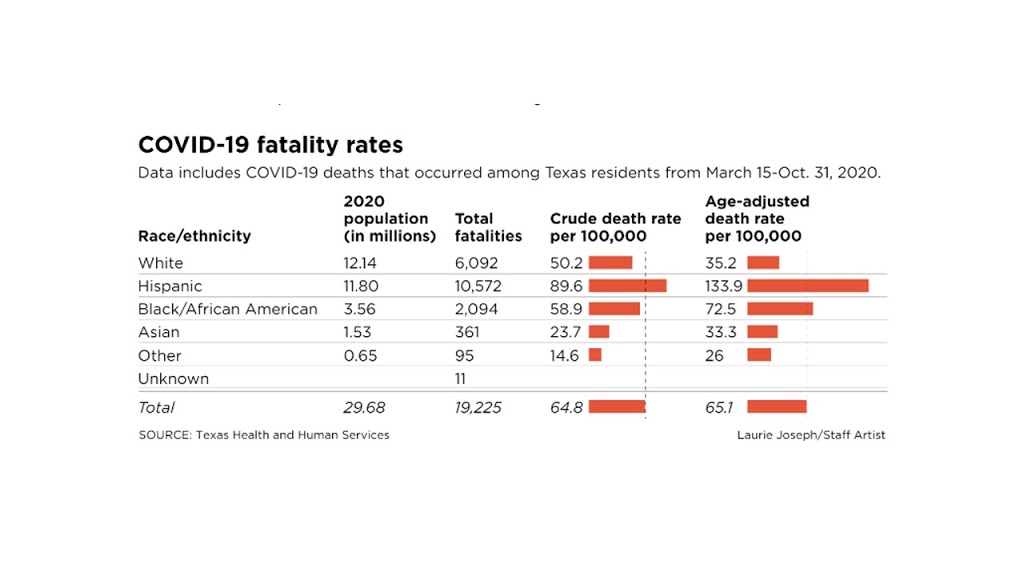
The release of a long-awaited report on Texas COVID-19 facilities by race-ethnicity was shocking.[1]Not because our community was unaware of race-ethnic disparities in vaccination rates but rather the large size of these disparities in Texas.  As the numbers for age-adjusted death rates per 100,000 revealed, Hispanics were nearly four times more likely to die (133.9) from the coronavirus than whites (35.2), while Blacks (72.5) were twice as likely to die as whites.  Asian death rates (33.3) were slightly lower than whites.

Texas State Rep. Shawn Thierry along with other lawmakers have been advocating for the release of this report in order to mobilize statewide efforts to target vulnerable groups like Blacks and Hispanics, although state officials have been reluctant to act more aggressively. In response to the release of this report, Rep. Thierry explained that the findings underscored the need to target resources to communities of color, especially since other data shows that white residents are getting vaccinated at higher rates than Blacks and Latinos. [2]

Given the high death rates for Latinos and Blacks, it is especially surprising that Texas state officials recently threatened to withhold vaccine doses that were allocated to Dallas County if they proceeded with a plan to target vaccinations to zip codes that included higher numbers of vulnerable Black and Latino residents.

Indeed, efforts to block targeted interventions to vulnerable communities contradicted recommendations by the National Academy of Sciences that recommended that “priority be given to ‘people who are considered to be the most disadvantaged or the worst off’ as defined by measures such as the Social Vulnerability Index created by the Centers for Disease Control and Prevention.” [3]

The announcement that the Biden administration will begin shipping vaccines to pharmacies throughout the U.S. was a major sight of relief for two reasons.  First, it minimizes the involvement of local politicians in the equitable distribution of the vaccines who have largely bungled the job in its communications, registration and distribution – resulting in higher vaccination rates of higher-income whites than lower-income Blacks and Latinos.  Texas politicians will also have less influence in threatening to withhold vaccines to jurisdictions that want to more aggressively vaccinate the more vulnerable communities of color.

Secondly, pharmacies are much easier to access for the elderly, Blacks and Latinos who encounter more barriers in registrations and obtaining vaccinations.  The Mega Centers are innovative in terms of providing a centralized location to vaccinate thousands of residents more rapidly; however, not all residents can travel to these Mega Centers or wait in line for hours during cold weather without access to restrooms or food.  The distribution of vaccines by pharmacies will not solve all the problems experienced thus far but should lead to significant improvements.

Given the gravity of the higher death rates for Texas Latinos and Blacks, it is disturbing to learn that Texas state officials are delaying any targeted interventions for these groups for several months.  Even more disturbing is that state officials threatened to withhold vaccine doses to Dallas County for attempting to follow the science by targeting the more vulnerable groups of Black and Latino zip codes.  The State of Texas deserves no praise for their callous response to the lives of its Black and Latino residents.


Reference Notes


[1]Morris, A.  (2021, February 2).  Report highlights disparities – but proposals targeting effects on minorities months away.  The Dallas Morning News, Accessed at: 

[2]Ibid.

[3]Cited in Warren, R.C. D.D.Sl, Dr.PH.H., M.Div., Forrow M.D., L., Hodge Sr., D.Min., Ph.D., and Truog, M.D., R.D.  (2020, November 26).  Trustworthiness before trust – COVID-19 vaccine trials and the Black community.  The New England Journal of Medicine.  Accessed at: https://www.nejm.org/doi/full/10.1056/NEJMp2030033      

Why Do Dallas-Area Public Officials Keep Fumbling the Ball on Programs Targeted to Multicultural Communities?

 Let’s give credit where credit is due. Dallas County and City of Dallas public officials have not won any accolades recently for decisions regarding programs that impact the quality of life for its multicultural community.The recent fiasco surrounding the distribution of the COVID-19 vaccine is the most recent example, but two other recent programs also come to mind – the Census 2020 Campaign and the lingering presence of food deserts in South DallasAs I will argue, these programs have one important thing in common that has posed a barrier to their success: the absence of quality research to guide decisions regarding public programs that are targeted to Black and Latino residents.

In 2020, I published a book entitled “The Culture of Research” that discusses the importance of conducting sound research in culturally and linguistically diverse communities and the consequences to decision making when such studies are missing or poorly conducted. Following are some insights derived from this book that should help the reader understand how sound research with multicultural communities could have produced improved outcomes in the management of the local COVID-19 vaccination program, the Census 2020 Campaign, and solving the mystery surrounding the persistence of food deserts in South Dallas.

COVID-19 Vaccine Awareness, Registration and Distribution

The local confusion and mismanagement associated with the COVID-19 vaccine distribution can be traced originally to the absence of guidance and transparency at the federal level, and the related decision by the previous administration to allow states to define their own independent strategies with a minimal financial support from the federal government.

Nonetheless, the COVID-19 vaccine distribution dilemma in Dallas County, Texas presents a good case study on decisions that public officials in urban communities should not make.   Indeed, the series of inconsistent and questionable decisions resulted in considerable public confusion and frustration with vaccine registrations, availability and distribution. Some of these missteps included the following:

  • Contradictory messages from county and city public officials;
  • Over-reliance on an Internet strategy to inform and register residents, many who lacked online access or own a computer, or were not comfortable with technology;
  • Inconsistent support in Spanish and other languages;
  • Placement of testing and vaccination sites in higher income while providing limited access in the more vulnerable areas; and  
  • Transportation barriers that prevented some residents to travel to testing or vaccination sites.
These missteps have resulted in higher numbers of white, higher-income residents getting vaccinated rather than the targeted, more vulnerable Black and Latino residents in the lower-income areas of South and Northwest Dallas. 

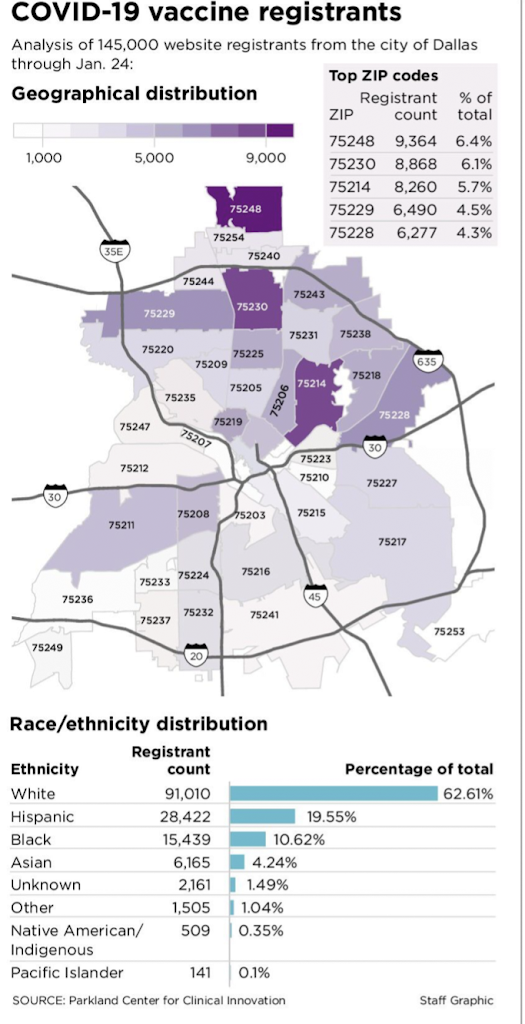
Figure 1:

Figure 1, published recently in The Dallas Morning News, clearly illustrates this pattern: [1]  whites comprised 62.2 percent of all persons vaccinated while representing 28.2% of the County population; Hispanics represented 19.5 percent of those vaccinated while comprising 40.8% of the population; and Blacks comprised 10.6 percent of those vaccinated although they represented 22.3% of the county population.  These disparities persist despite recent efforts by public officials to communicate more directly with civic leaders, churches and community organizations to improve vaccination rates for Blacks and Latinos in the South and Northwest part of Dallas.

The problem associated with vaccine distribution in communities of color is deeply concerning because they are the most likely to experience the more serious medical consequences from the coronavirus.  Importantly, these missteps in decision making could have been avoided with communications that were better coordinated by public officials and engagement of experts with significant experience engaging multicultural persons. 

The decision to use an Internet vehicle for the vaccination campaign is very likely the reason that white, higher income residents continue to be more successful in getting vaccinated. Although some public officials supported the idea of targeting zip codes in South Dallas that included some of the most vulnerable Black and Latino residents, the Texas State Health Department[2]immediately issued a threat to withhold vaccine doses allocated to Dallas County if the targeting was implemented.  This threat was a direct contradiction to recommendations by the National Academy of Sciences that support vaccine community intervention programs that are targeted to the most vulnerable communities. [3]  Thus, Dallas County and City of Dallas public officials learned the hard way that launching a public vaccination program in linguistically and culturally diverse communities require less reliance on technology and more reliance on outreach efforts that take the vaccines to the residents.  Ironically, while the state threatened to withhold vaccine doses if local officials employed a zip-code targeting approach in South Dallas, the use of an Internet strategy as the primary form of communication accomplished the same outcome by vaccinating higher numbers of white, higher-income residents who resided in the northern parts of Dallas County.

South Dallas Food Deserts

Why have mainstream supermarkets avoided South Dallas food deserts that are populated by lower-income Blacks and Latinos?  [4]This question inspired me to conduct a geospatial analysis using crime, demographic and supermarket expenditure data to examine the common reasons cited by supermarket executives to explain the avoidance of communities like South Dallas – such as high crime, low population density, lower household median income and insufficient food expenditures.  The study revealed that crime patterns were often inflated by previous investigators and news stories, and that the annual food-at-home expenditures in several food deserts in South Dallas were adequate to sustain the annual sales of a mainstream supermarket.  Flawed crime analyses, stereotypes of urban retail, and an apparent disdain for Black and Latino customers appeared to drive site selection decisions in South Dallas.

Over the past two decades, the City has floundered millions of taxpayer dollars on ill- conceived investments that failed to produce positive changes in the supermarket options for this community. Worst yet, a market demand study of community residents – a traditional practice to measure supermarket opportunities — has never been conducted in South Dallas. Such a study would have provided supermarket and site selection executives the statistical evidence needed for an investment decision. In the meantime, South Dallas residents will be forced to continue shopping outside of their community for healthy, affordable food or visit the less desirable dollar stores.  Once City public officials decide that the South Dallas community is deserving of a high-quality supermarket experience, a professional, high quality market demand study is the best approach for making this a reality.  If supermarket redlining practices continue in South Dallas despite solid evidence of its retail potential, it might be a good idea to recruit a supermarket chain from outside of Dallas County or Texas that reveals a greater interest in serving Black and Latino consumers in urban communities. 

The Census 2020 Campaign

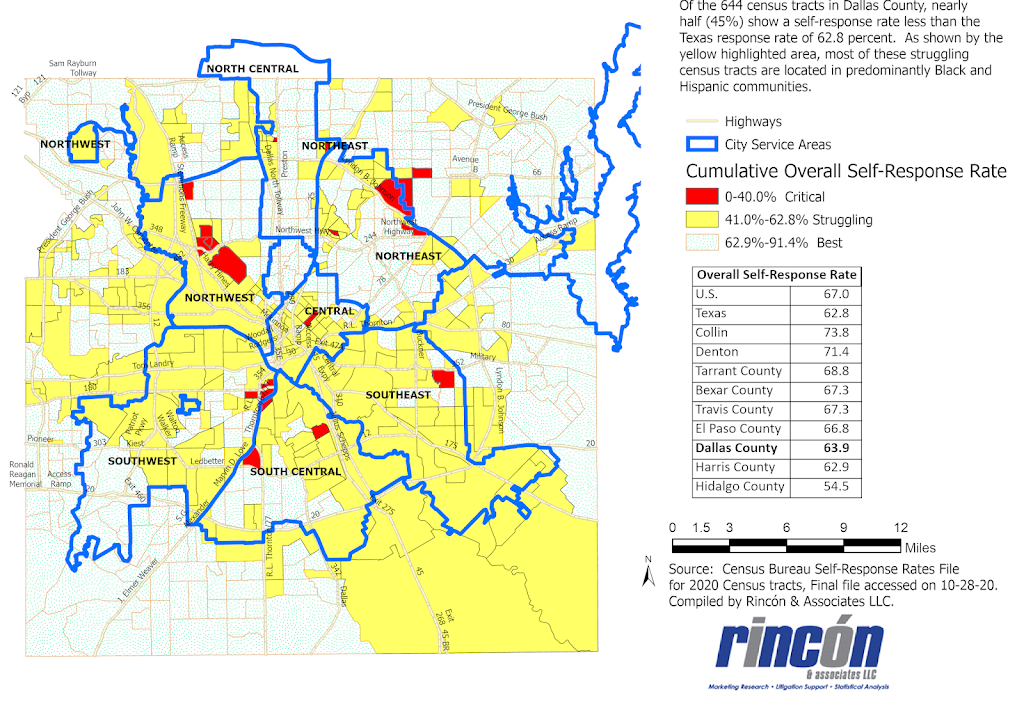
In January 2020, Dallas County and the City of Dallas funded a $1.9 million Census 2020 Campaign to provide a comprehensive strategy to boost response rates in hard-to-count communities that were populated by lower-income Blacks and Latinos. The team selected to conduct the campaign submitted a report summarizing the multitude of campaign activities that they conducted from February to August of 2020 to target these HTC communities.  To monitor progress on this campaign, I produced maps on a monthly basis that illustrated the cumulative self-response rates by census tracts that were provided by the Census Bureau.  Figure 2 below shows that the final self-response rates reported by the Census Bureau were decidedly lower in the southern and northwest parts of the city where HTC Blacks and Latinos resided.  In fact, the table of Overall Self-Response Rates indicates that Dallas County ended with one of the lowest self-response rates (63.9%) compared to other large Texas counties.  Consequently, the Census Bureau was required to deploy many more field interviewers in order to minimize the potential population under-count, an especially difficult task during the pandemic.  Despite its best intentions, the Census 2020 Campaign funded by the County and City appeared to fall short of its intended goal in hard-to-count communities and will likely lead to the loss of millions of federal dollars for local programs. Although the pandemic posed a barrier to response rates during this period, the burden on Dallas County was likely similar for all other counties considered here.

                 Figure 2: Dallas County 2020 Self-Response Rates by Census Tract and City Service Area

Part of the challenge in completing the Census 2020 questionnaires can be traced to the reliance that the Census Bureau placed on using an online survey as their major data collection strategy. In past censuses, the Census Bureau relied primarily on a mail questionnaire, while data collection for the annual American Community Survey has utilized a mixed mode strategy that included mail questionnaires, telephone interviews, personal interviews and online surveys.  Not surprisingly, Black and Latino respondents to the American Community Survey have opted for telephone and personal interviews more often than whites or Asians, while online surveys were the least chosen option.

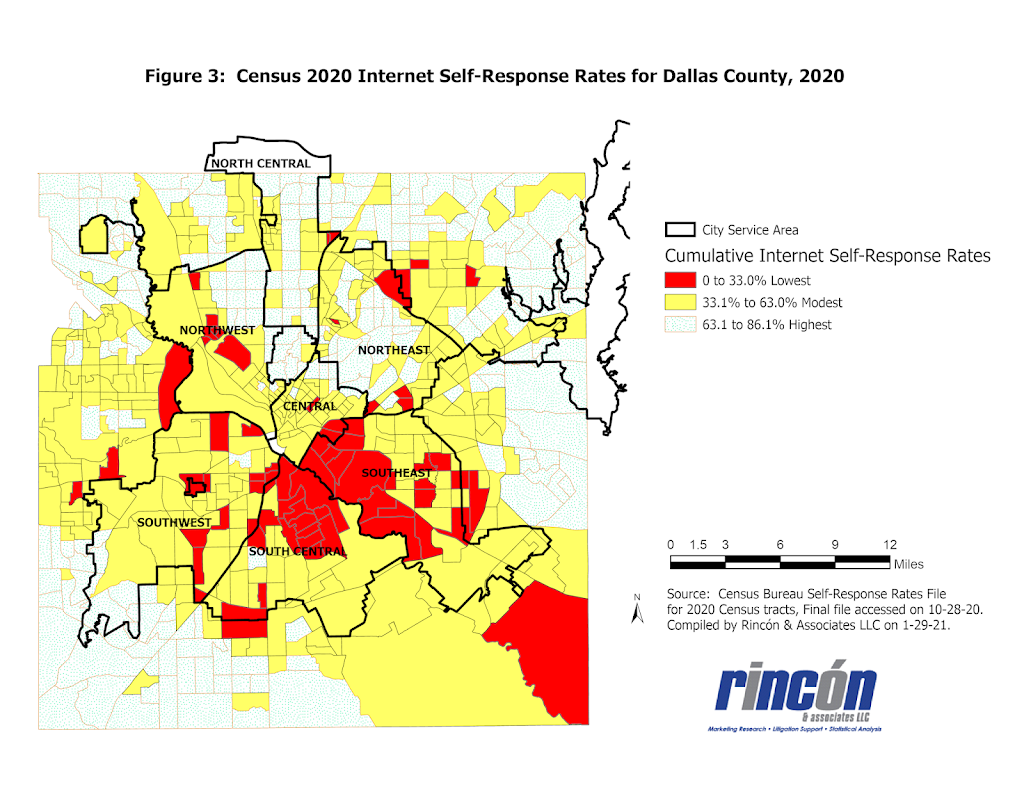
Figure 3 below presents the percentage of Dallas County households that completed the Census 2020 using an online survey.  The map presents the cumulative Internet self-response rates for the 2020 Census as of October 28, 2020.  Of the seven City Service Areas (CSAs), the Central, Southeast, South Central, Southwest and Northwest CSAs are populated primarily by lower income Blacks and Latinos. It is clear that these CSAs included census tracts (highlighted in red) with the lowest online response rates, while the numerous other census tracts (highlighted in yellow) showed modest online response rates.  The highest online return rates were realized for census tracts in the northeast and north central CSAs that were populated primarily by white, higher-income residents.
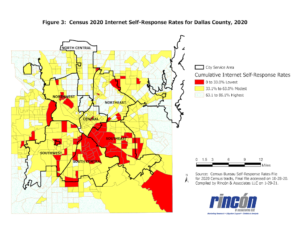

Throughout 2020, public officials in Dallas County and City of Dallas were aware of the poor performance of the Internet to encourage poor Blacks and Latinos to complete the 2020 Census.  Why then was the Internet the main vehicle used for communications related to COVID-19 vaccine awareness, registration and distribution?  Good research and multicultural expertise would have been beneficial to decision makers during this period.

Based on my past 45 years of experience in conducting surveys of multicultural populations, it is my opinion that the Census 2020 Campaign sponsored by Dallas County and City of Dallas was not guided by the best expertise regarding the strategies for successfully engaging multicultural population segments in surveys and the biennial census.  If it had been, Dallas County might have experienced a higher ranking in Census self-response rates in comparison to the many Texas counties that did not allocate any funding for a Census 2020 campaign.

Some Concluding Thoughts 

The challenges facing public officials to ensure a satisfactory quality of life for all community residents have become more complex and will require careful planning using the best expertise in understanding and engaging culturally and linguistically diverse communities.  Public officials must resist the temptation to take the path of least resistance by overlooking or dismissing the need for solid research to guide decisions that impact the quality of life of multicultural residents. Dallas County and City of Dallas public officials learned the hard way that engaging culturally and linguistically diverse residents is a complex task that requires multicultural expertise and support from community organizations. As the population of urban areas like Dallas County continues to grow and evolve demographically, the challenges to respond more effectively to important community needs and events will become more challenging.  Let’s hope that public officials will be better prepared to respond.


Reference Notes

[1] Garcia, N. and Jimenez, J. (2021, Jan. 28).  White Dallas residents outpace Blacks, Hispanics in registering for COVID vaccine.  Dallas Morning News, Accessed at:  https://www.dallasnews.com/news/public-health/2021/01/29/white-dallas-residents-outpace-blacks-hispanics-in-registering-for-covid-vaccine/

[2] Choi, J. (2021, Jan. 21).  Texas threatened to reduce vaccine supply to Dallas County over plan to focus on ‘vulnerable’ ZIP codes.  The Hill.   Accessed at: https://thehill.com/homenews/state-watch/535294-texas-threatened-to-reduce-vaccine-supply-to-dallas-county-over-plan-to

[3]National Academy of Sciences, Engineering and Medicine (2020). Framework for equitable allocation of COVID-19 vaccine. Washington, D.C.: National Academy Press.


[4] Rincón, E.T. and Tiwari, C. (2020, March 23). Demand metric for supermarket site selection:
 A 
case study. Papers in Applied Geography,  Accessed at: https://doi.org/10.1080/23754931.2020.1712555

Careless Decision Making Creates Race-Ethnic Disparities in Distribution of COVID-19 Vaccine


The recent story in The Dallas Morning News was clear and disturbing: 

”COVID vaccines at Fair Park aren’t going to Black, Latino residents as officials hoped” [1] 

The story chronicles the missteps in public communications efforts to schedule large-scale vaccinations to historically disenfranchised neighborhoods, which are mostly Black and Latino and below Interstate 30 – groups that have experienced a higher number of illnesses, hospitalizations and mortalities during the pandemic.  Instead, however, the thousands of residents that showed up for the vaccinations at Fair Park were mostly white North Texans from higher-income neighborhoods following mixed messages to the public – many showing up in their Mercedes, Infiniti and BMW automobiles. 

Dallas City Mayor Eric Johnson blamed County Judge Clay Jenkins for the confusion generated by the announcement to register online with the county to receive a vaccine appointment at the South Dallas Mega Center – an announcement that was apparently not coordinated with the Mayor’s office. Word of mouth spread rapidly that an appointment was not needed for residents 75 and older – which left thousands of others on a waiting list and encouraged many out-of-town residents to show up for a vaccine.  County officials pointed out that a significant number of residents who showed up were able to access an unsecured web link that allowed them to book an appointment, regardless of age or status.  Other residents who showed up also pointed to emails received from the county encouraging them to sign up for an appointment.

Interestingly, Dallas County was not prepared to release a demographic profile of those that received vaccinations, a report that would have been very useful in evaluating the extent of the exclusion of more deserving Black and Hispanic residents in the targeted community.  As an apparent after-thought to expand access to the intended Black and Hispanic residents,  Jenkins and his staff began reaching out to leaders in those communities, including elected officials, faith leaders and other organizations that work in communities where the coronavirus was most prevalent.

The vaccine distribution fiasco in Dallas County is not an isolated one as many communities throughout the U.S. are struggling to coordinate the vaccinations using a confusing set of federal guidelines that are implemented inconsistently thoughout the nation.  In a previous blogpost, I had warned about potential problems that could complicate the distribution of the vaccines once they became available.  For example:

·        The Center for Disease Control decided to exclude Blacks and Hispanics from the category of “high-risk” groups, thus reducing their priority level for intervention strategies. Why?  Because the CDC concluded that the high virus rates are not due to genetics, and they want to avoid stigmatizing these groups as “COVID carriers.” [2]

·        Race-ethnic information is missing for many of the cases, hospitalizations and mortalities recorded for COVID-19, which obscures the accurate reporting of this information for Black and Hispanic communities – a consequence of lax mandates for recording race-ethnic information. The absence of this information obscures the true picture of community spread of the virus. [3]

·        Access to testing sites in states like Texas is problematic since these sites are more commonly located in white communities than the more vulnerable Black and Hispanic communities. [4]

It is also disturbing to learn that states like Florida have relaxed the requirements for vaccine eligibility by allowing anyone over the age of 65 years to obtain a vaccine, which has encouraged many tourists and out-of-town residents to drain the vaccine supplies at the expense of more deserving local residents.

In the case of Dallas County and the City of Dallas, it was unfortunate that better coordination was not in place to implement such an important vaccine intervention program at the Fair Park Mega Center.  However, even if the communications had been better coordinated, there is still one important tactical decision that could have produced a different outcome.

In my opinion, it was a major mistake to rely primarily on a web-based strategy to encourage Black and Latino residents in the targeted communities to register for the Mega Center vaccination. From their recent experience to encourage response rates to the Census 2020, both Dallas County and City of Dallas officials were aware that Black and Latino residents, especially immigrants, were excluded in large numbers from completing the Census questionnaire which also primarily relied on the Internet.  Our past research in multicultural communities confirms that Blacks and Hispanics are more likely to respond by telephone, mail and personal contacts when completing surveys and Census questionnaires but least likely to respond by using the Internet. Lastly, a Census population pyramid easily illustrates that a much larger proportion of whites are concentrated in ages 65 and older than Hispanics or Blacks – which would provide whites a distinct advantage when using eligibility criteria based on age alone.

For damage control, Jenkins reportedly began outreach to community elected officials, faith leaders and other organizations in the targeted zip codes – an approach that should have been followed initially. Whether by intent or just careless decision-making, Mr. Johnson was correct in stating that the county was “promoting a system that gave preferential treatment” – that is, to white, higher-income residents who were not the intended target audience of the Mega Center.

With COVID-19 vaccinations, there is less room for error in the fair distribution of a life-saving solution.  Let’s hope that public officials agree to improve the coordination of public vaccination campaigns by improving their communication strategies in culturally diverse communities.


Reference Notes


[1]Garcia, N. and Bailey, E. (2021, January 14). COVID vaccines at Fair Park aren’t going to Black, Latino residents as hoped.  The Dallas Morning News.  Accessed at: https://www.dallasnews.com/news/public-health/2021/01/14/dallas-mayor-eric-johnson-blasts-county-after-walkups-allowed-at-covid-19-vaccine-mega-site/

[2] Rincon, E.T. (2020, July 30) CDC blunders in excluding communities of color among high risk groups for COVID-19. https://www.rinconassoc.com/cdc-blunders-in-excluding-communities-of-color-among-high-risk-groups-for-covid-19

[3] Rincon, E.T. (2020, April 16). Missing race-ethnicity data complicates COVID-19 mortality counts, but the solution is simple. Accessed at: https://www.rinconassoc.com/missing-race-ethnicity-data-complicates-covid-19-mortality-counts-but-the-solution-is-simple

[4]Fanning, R. (2020, May 29). Across Texas, black and Hispanic neighborhoods have fewer coronavirus testing sites. Texas Standard. Accessed at: https://www.texasstandard.org/stories/across-texas-black-and-hispanic-neighborhoods-have-fewer-coronavirus-testing-sites/

Texas Hispanic Construction Worker Mortalities Are Alarming: Is Anyone Listening?

The news was alarming: Hispanic construction workers represent over half (56%) of the state’s COVID-19 deaths although Hispanics currently represent 40 percent of the state’s population.  The story, reported today by The Dallas Morning News,[1]discussed the results of a research study published in the Journal of the American Medical Association (JAMA) by a team of researchers at The University of Texas at Austin. The study pointed to the increased risk faced by Hispanic construction workers and living arrangements that preclude social distancing.

The story is also concerning for the issues that were not addressed. For example, the story did not include any comments from the one organization in North Texas that would have relevant insights to contribute to our understanding of this elevated health threat to Hispanic construction workers:  The Regional Hispanic Contractors Association.  

Previous COVID-19 news reports have focused considerable attention on essential workers in healthcare, the food industry and other occupations. However, the risks faced by construction workers have received relatively little attention, especially Hispanic workers who comprise 30 percent of all construction workers. Under the current administration, OSHA (Occupational Safety and Health Administration) has relaxed their inspections of occupations to verify compliance with COVID-19 safety measures which has undoubtedly contributed to the increased risk faced by Hispanic workers who often do not wear face masks.

Of course, we have known for several months that Hispanics and Blacks have been experiencing higher levels of COVID-19 illnesses and mortalities.  As I discussed in an earlier report,[2]  these COVID-19 mortality rates are likely much higher for Blacks and Hispanics since state and federal health data are often missing information on the race or ethnicity of COVID-19 mortalities. There is a simple procedure available that can estimate the race-ethnicity of a person based on their name and zip code with 80 to 90 percent accuracy – a tool that could be used to fill in the missing data and obtain a better estimate of COVID-19 mortalities.  

Communication of these alarming health risks to the right audiences is also problematic. For example, it is not likely that the Hispanic construction workers and families that need to know about their elevated risk of death related to COVID-19 will read the report in JAMA or The Dallas Morning News.  During the pandemic period, audiences are more likely to obtain news information from television and online sources if they have Internet access. And Hispanic construction workers are more likely to use Spanish-language sources of information.  Consequently, it is imperative that Spanish-language television stations like Univision and Telemundo assume an increased responsibility to ensure that COVID-19 health alerts are regularly communicated to their audiences.  Moreover, organizations like the Regional Hispanic Construction Association are perhaps the best vehicle to deliver and reinforce the health alerts to their membership.

While the issue of increased COVID-19 exposure and deaths of Hispanic construction workers is urgent, one wonders if the study findings will be sufficient to wake up the various stakeholders to take decisive action. As the story points out, Dallas-Fort Worth is second among the country’s largest building markets in September this year with an estimated 155,000 workers in the building sector.  But as one of the study authors, professor Lauren Meyers pointed out, the study findings do not necessarily mean that construction work needs to stop. “It means that we need to go to great lengths to ensure the health and safety of workers when they do go to work.” 

In the meantime, let’s ensure that Hispanic construction workers and their families are informed about the elevated risks that they face from COVID-19 and, more importantly, that they are provided practical solutions to mitigate the risks.  Following are a few suggestions for achieving these objectives: 

  • Being the second highest building market in the nation, it seems reasonable to ask investors and builders to create a fund that is dedicated to keeping the Hispanic contractors and workforce safe and able to meet basic expenses. 

  • Create a fund to offset the costs of funeral expenses for the many Hispanic families who have lost a family member working in the construction industry.
  • Pressure OSHA to conduct more frequent checks of construction work sites to ensure that workers are following COVID-19 safety guidelines and have a sufficient supply of PPE supplies.
  • Provide funding for temporary shelter, such as trailers or hotel rooms, to provide family members the opportunity to quarantine themselves when necessary from exposed construction workers. 
  • Ensure that all construction workers are tested for the COVID-19 virus before starting their work shift.
  • Provide continuing funding to organizations such as the Regional Hispanic Contractors Association so that they are able to conduct the needed training to Hispanic contractors regarding COVID-19 safety measures and risks.
  • Lastly, ensure that all COVID-19 related communications are delivered in both English and Spanish languages.  Native-born Hispanics primarily view English-language media while foreign-born Hispanics primarily view Spanish-language media – a fact that we have confirmed from our 45 years of evaluating the media habits of Hispanics throughout the U.S.

End Notes


[1] Difurio, D. (2020, October 31).  Construction workers hit hard by virus. Dallas Morning News. Accessed at https://edition.pagesuite.com/infinity/article_popover_share.aspx?guid=6e7208df-d7f4-44e9-af63-fef33cd734fb

[2]  Rincón, E.T. (2020, April 16).  Missing race-ethnicity data complicates Covid-19 mortality counts, But the solution is simple.  https://www.rinconassoc.com/missing-race-ethnicity-data-complicates-covid-19-mortality-counts-but-the-solution-is-simple

CDC Blunders in Excluding Communities of Color Among High Risk Groups for Covid-19

It really makes little sense.  Despite the fact that Blacks, Hispanics and Native Americans are being hospitalized and dying at considerably higher rates than whites in the U.S., the Center for Disease Control recently changed its definition of Covid-19 high risk groups to exclude these groups.[i]  Why?  Because they have concluded that the high virus rates are not due to genetics, and they want to avoid stigmatizing these groups as “Covid carriers.”  By taking this action, the CDC can now remove their priority status for the delivery of health services – a disturbing action that suggests the injection of partisan politics.
 Let’s consider the fact that older persons were initially identified among the high-risk groups and remain in that category for good reasons. Indeed, one would not argue that their high-risk status should be changed because they often reside in nursing or retirement homes that have been plagued by the coronavirus. The purpose of identifying key demographic characteristics that are associated with the prevalence of a disease or virus is to target intervention strategies towards such groups as quickly as possible to mitigate the spread of the disease or illness – regardless of the circumstances that created their vulnerability – such as social determinants like comorbidities, living arrangements and working conditions.  

The CDC’s justification for re-defining the high-risk categories – to avoid stigmatizing these groups as “Covid carriers” – is specious.  Communities of color have long been stigmatized in many industries for the wrong reasons, including their skin color, language and many other attributes.  Assigning a high-risk category for Covid-19 is a health-related assessment, not a stigma, and should not be used as a basis for denying health-related services as the CDC is apparently proposing.
What seems plainly obvious is that the Trump administration has forced the hand of the CDC experts once again.  First by re-directing the reporting of Covid-19 hospitalizations from the CDC to the Dept. of Health and Human Services to the great dismay of the national health community.  Secondly, by pressuring the CDC to moderate the perceived risk of attending schools in person despite the increasing infection rates in many communities. And now by re-defining Covid-19 high risk groups with a questionable rationale.
These actions are setting the stage in the U.S. for the unfair distribution of the Covid-19 vaccine once it becomes available, a disturbing scenario that is likely to deprive the vaccine from communities of color and other groups that have been re-defined as lower risk by the CDC. By allowing this new definition of risk by the CDC to continue unchallenged, communities of color can expect a longer period of infections and mortalities from the pandemic, and more limited access to a vaccine once it becomes available.  There is a clear need for strong advocacy from civic, business and community groups that represent communities of color to challenge and correct the direction that the CDC has taken in defining high-risk groups for Covid-19.   
References


[i]Associated Press (2020, July 25). US agency vows steps to address COVID-19 inequalities.  WFAA, accessed at https://www.wfaa.com/article/news/health/coronavirus/coronavirus-inequalities-cdc/507-a770cfc8-9967-4359-b84d-12684c6aa46f